The world is evolving at a rapid pace, and territories are no exception. Faced with growing challenges related to development, risk management, energy transition, and climate change, it has become imperative to understand territorial dynamics and to develop effective and sustainable management strategies.
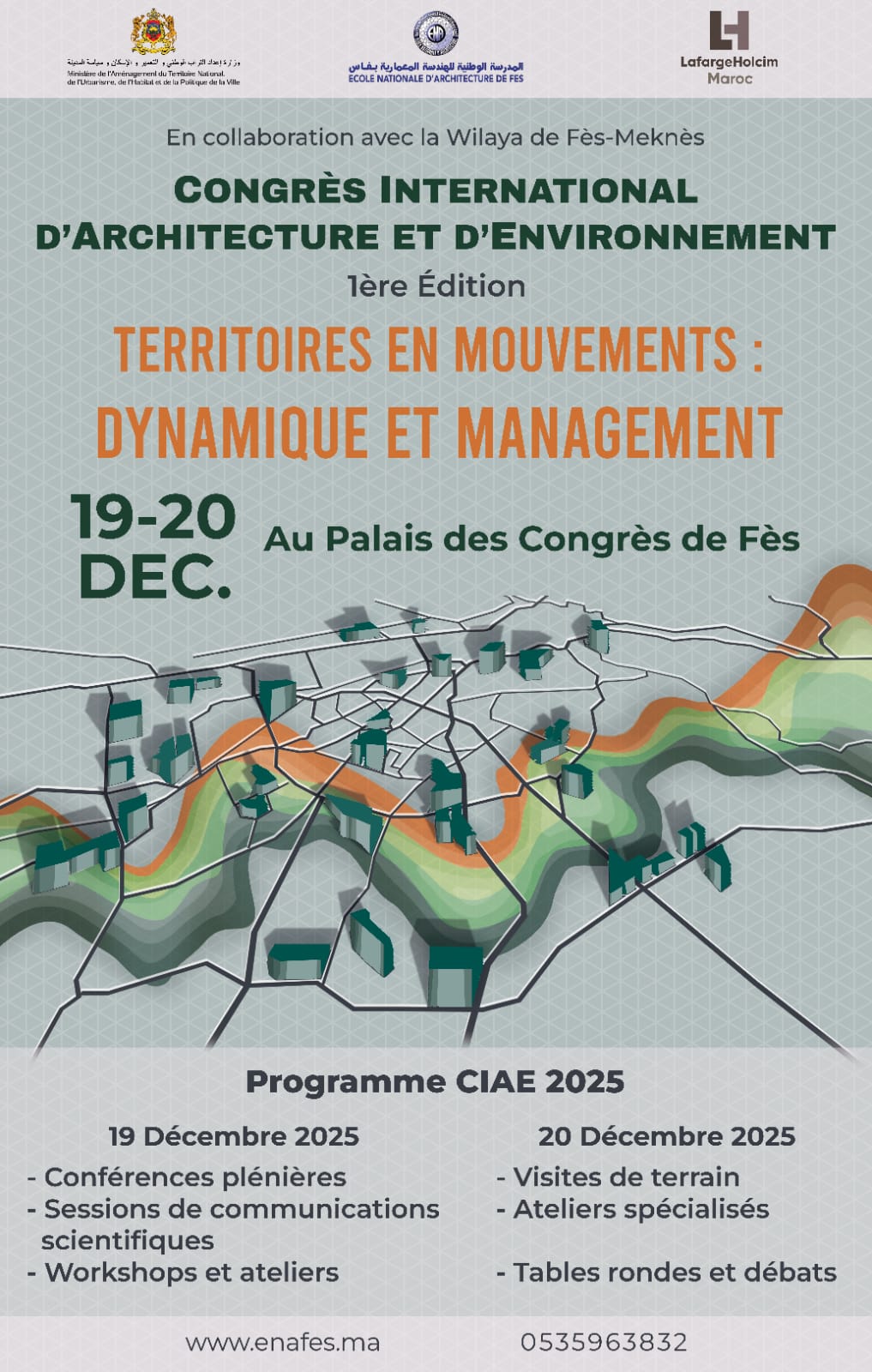
In this context, the National School of Architecture of Fez, in partnership with LafargeHolcim Morocco, is organizing the first edition of the International Congress on Architecture and Environment (CIAE’2025) under the theme: “Territories in Motion: Dynamics and Management”, to be held in Fez on December 19–20, 2025.
This event will bring together researchers, experts, decision-makers, and practitioners from diverse fields to exchange views on territorial transformations, share experiences, and propose innovative approaches in planning, resilience, and territorial sustainability.
The CIAE’2025 thus aims to be a space for scientific and professional reflection and dialogue, fostering networking and the co-construction of solutions adapted to contemporary challenges.
Thematic Axes
Submissions are expected to address one of the following themes:
1. Territorial development and sustainability
Analysis of territorial development models integrating sustainable development principles. Studies on spatial dynamics, territorial governance, social equity, circular economy, and strategies for reconciling growth with environmental preservation.
2. Risk management and territorial policies
Methods and tools for identifying, assessing, and managing natural, technological, and socio-economic risks. Role of public policies and regulatory instruments in prevention, mitigation, and territorial resilience.
3. Territories, energy, and transitions
Energy transition and integration of renewable energies in territories. Energy sobriety policies, efficiency of urban and rural systems, and the impact of energy transitions on spatial structuring.
4. Water stress and climate change
Adaptation and resilience approaches in the face of water scarcity. Integrated water management, impacts of climate change on territories, technological innovations, and nature-based solutions for water preservation and valorization.
5. Urban planning and digital territorial development
Tools and methods of urban planning integrating digital technologies (GIS, 3D modeling, digital twins). New forms of spatial governance, smart cities, and urban adaptation strategies in response to contemporary transformations.
6. Resilient infrastructures and environmental engineering
Design, management, and maintenance of infrastructures capable of withstanding natural, technological, and climatic hazards. Innovations in environmental engineering, sustainable materials, and green infrastructures fostering territorial resilience.
7. Sustainable mobility and transport engineering
Development of ecological, inclusive, and efficient transport systems. Reduction of greenhouse gas emissions from mobility, integration of soft modes of transport, multimodal planning, and innovations in transport engineering.
8. High-performance environmental buildings
Design and rehabilitation of buildings meeting energy and environmental performance standards. Bioclimatic approaches, use of ecological and bio-based materials, and implementation of energy efficiency solutions.
9. Integrated management of natural resources
Strategies for the preservation and enhancement of natural resources. Territorial approaches to circular economy, sustainable resource exploitation, and policies balancing human and ecosystem needs.
10. Environmental assessment and decision-making tools
Methods and tools for environmental assessment applied to territorial and urban projects. Development of indicators, simulation models, and digital tools to support decision-making and integrate social, economic, and environmental dimensions.

 Loading...